Sunday, May 31, 2009

Photos from Dharamsala

I spent the middle of the trip in the cooler Dharamsala, a small mountain town in the state of Himachal Pradesh. The state borders Tibet, with the Himalayas acting as a natural border. Most refugees who came straight to India did so through a treacherous passage through the Himalayas that takes up to two weeks, including the Dalai Lama himself, who fled Tibet in 1959. From Dharamsala, you can see the Himalayas in the distance. Planes land in the Dharamsala airport in the Kangra Valley, then it's an hour ride up treachorous dirt roads that are very, very steep and often one lane even though traffic goes in two lanes. Dharamsala contains the largest gathering of Tibetan refugees in the world and is the seat of the Tibetan Government-in-Exile.

Most of "downtown" Dharamsala is actually McLeod Ganj, named after a British Governer of Punjab. It's not any flatter than any part of the mountain, but it's based around the Tsuglagkhang Complex, which contains a monastery and most importantly the private residence of the Dalai Lama, which was gifted to him by Prime Minister Nehru upon his arrival to India. The Dalai Lama does all of his public teachings and most of his press conferences in the main temple complex, either on his throne or sitting in front of it. Pictures of thrones that contain a picture of the Dalai Lama mean that only he can sit there, even if other people are meeting without him. They leave the throne empty.

Dharamsala is cooler than most of India because of the elevation, which meant it was hot but not unbearably, and in the winter it snows. None of the hotels have air conditioning, and the majority of them are, by normal standards, not very good. On the other hand, they are all very cheap. I was staying at one of the most expensive hotels, and I think I was paying about $42 a night, which was worth every penny. Dharamsala is safer than most Indian areas for tourists, with lots of women seen walking alone, and there's all kinds of cuisines, from Tibetan to Israeli to Italian. The town is particularly popular for Israelis, and many of the signs are in Hebrew. Despite the presence of so many Tibetans, Indians own all of the land because the Tibetans are refugees and are not allowed to own land, even if they were born here as a child of refugees. So many of the shop owners, hotel owners, staff, and especially construction workers are Indian.

A very interesting place. If you're not tremendously fascinated by Tibetan culture, you can do the town in a day, maybe two. I was there for four, not counting Shabbos, and saw pretty much everything. Also I used the time to rest from the pace of the trip, as I get sick when I get overtired, so it was good for me.

Also there were a lot of monkeys.


Thursday, May 28, 2009

Photos from Amritsar

Going out of order here, these are my photos of Amritsar, which I spent a day in between Dharamsala and Delhi. Amritsar is in the Indian state of Punjab, about forty minutes from the border with Pakistan. The last ground war with Pakistan in 1971 was fought along the Punjab border. Today the border is stable and somewhat peaceful, with trade of textiles and food crossing the border both ways and a colorful ceremony on the Wagah Border each night as both countries lower their flags at the same time. The ceremony was a surprise, as I didn't notice "going to Pakistan" was really on my itinerary until we were on the road to it. I asked if they would let me put my foot in, like the time that my parents took me to Colorado and we stopped at the state border and I put my feet into Utah or something, so I could put a foot in and say, "Hey, I was in Pakistan." Actually Wagah is a no-man's land anyway, and even so they wouldn't let us get within 20 feet of the opposite gate. The ceremony was fascinating not really for its pageantry of the soldiers walking back and forth to salute each other, but for the crowds on both sides. On the idea side, there was color and and crowds dancing and the place was packed. On the Pakistan side, the amphitheater was about 2/3rds empty, men and women were seperated, and the men were wearing mostly white and the women mostly black. Both countries had sort of an MC, who would signal the crowd to cheer for their country (which in India's case was "Hindustan!") and then the other MC would do the same to compete on the other side ("Jia Jia! Pakistan!"). The Pakistani side did a good effort of keeping up the noise for how few they were in numbers, but perhaps the most poignant moment was after the actual ceremony, when the crowds were allowed to come to the bars of the two gates, 20 feet apart, and both sides waved to each other and took pictures with their cameras. People forget that before the Partition, Pakistan was part of India, and millions of people were displaced when the Hindus went one way and the Muslims went another. The Sikhs dominate the Punjab state, and the ones on the Pakistani side have had to endure a heavy non-Muslim tax, which angers India.


Primarily, Amristar is the holy city of the Sikhs, a religion whose members wear turbans and are often mistaken for Arabs in this country. Sikhism was founded by Guru Nanak, a 15th-century sage from Lahore (now in Pakistan), who came west to discover a caste system he didn't care for, so he was inspired to create a religion anyone could join and that did not have a caste system. Sikh men and women cover their hair, men grow beards, and they are supposed to always have on them five things: uncut hair, underwear, a silver bracelet, a comb, and a ritual dagger. The last thing created a mess in the Amtrak station in Providence either on 9/11 or the day after (I forget), when a Sikh man had his bags searched by some racist security guards who assumed he was Arab and found his ritual dagger, which created quite a stir in Providence before things were sorted out.

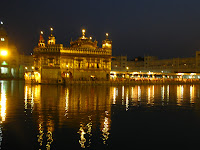
The holiest site is the Golden Temple, built in 1577 and really one of the most incredible buildings in the world. It is plated with gold, and though it is forbidden to take photographs inside, I managed to snap a few, but they are sideways. The pool surrounding it is the Pool of Nectar, which comes from a fresh spring of water and people bathe in it for health and penance. The Golden Temple is open about 20 hours a day, and closed around midnight for cleaning, but the complex is open 24 hours a day and 24 hours a day they have someone reading the sacred book of the Sikhs over the loadspeaker. Food is free for all pilgrims, as is guest housing, though I would recommend a hotel. It was very hot there when I was there, probably 100 or 105 degrees, but it wasn't unbearable. They were very serious about guests removing their shoes and covering their hair. I also visited it briefly the night before the official visit to get some pictures. Unlike other sites in India, admission is free for all at all times. I was really happy for the chance to go. Amristar is fairly far north of Delhi, so originally I scratched it off my list even though I mentioned it in book 10 of my series, but then I discovered it was only a few hours from Dharamsala, so not terribly out-of-the-way. The return to Delhi was a 6-hour train ride.
My final stop in Amritsar was Jallianwala Bagh, a park which was the site of a British massacre of civilians in 1919. The episode spurred on the Indian Independence movement and is a major event in the movie Gandhi. One of the most notable monuments is the well of matyrs, where people fell to their death to escape the hail of bullets.

Jallianwala BaghThe next few days are Shavuos, but after the holiday I will get up my pictures from Delhi, from traveling, and of course, Dharamsala.

Wednesday, May 27, 2009

Photos from Jaipur

Jaipur, part of the afore-mentioned "Golden Triangle," is the capital city of the Indian state of Rajastan. Founded in 1727 by iSingh II, who previously ruled the city of Amber just outside, it was nicknamed "the Pink City" because it was painted pink for the arrival of a British prince, and because the stones from Rajastan's quarries have a natural reddish shade to them. Jai Singh also built Jantar Mantar, an astrological observatory. Rajastan remained fairly independent during the British Raj and the ruler was only stripped of his power after Indian Independence. The current Maharajah still lives in the city palace but has no actual political power.


Jantar Mantar, an astrological observatory built by Jai Singh II


The Amber Fort just ouside Jaipur

Tuesday, May 26, 2009

Photos from Agra

Agra is a city in the Indian state of Uttar Pradesh. It's part of what's called the "Golden Triangle" of Delhi/Jaipur/Agra, all important tourist cities for their Mughal palaces and other heritage sites and cities that are within driving distance of each other (5-6 hours), forming a triangle that can be done in a few days. I spent a total of about 24 hours in Agra, from May 13th to 14th, visiting the Red Fort in the afternoon of the 13th and doing the Taj Mahal at sunrise before leaving for Delhi and my plane to Dharamsala. Agra was the capital city of the Mughal Emperors between 1526 and 1658.


I have too many pictures to label every one, so I put them into sets.


Monday, May 25, 2009

More Video!

Two new things up:
(1) My final video, a Hindu ceremony in Jaipur


(2) Pictures from my trip to the Church of St. John in the Wilderness, near Dharamsala. Click on the picture below for the set.


Friday, May 22, 2009

Video!

I got through the mid-morning "I am really tired" hump by going to see Star Trek, which exceeded my expectations, but now I'm in the mid-afternoon "I am really tired" hump. Shabbos isn't until 7:56 pm, so I'm going to try to make it until then and just go to bed for the night, hopefully licking the jet lag. It's worth the effort.

I've uploaded some videos before Shabbos. There's one more of a Hindu ceremony, but it's four minutes long and will take longer to upload.

Worshipers at the Dalai Lama's Temple in Dharamsala performing prostrations:


The lowering of the Indian and Pakistani flags for the evening at the Wagah border, in the Indian state of Punjab near Amritsar:

Live from ... Where am I? Jersey. Yes. Sounds right.

I am home, and a little bleary, as I have to make it until about 7 pm to beat the jet lag and I've been up since what you all would consider 1 am, with very little sleep before that thanks to the overly-curious 4-year-old in the seat in front of me who had to ask his mom about everything. Mid-morning is always the hardest, I remember from my many trips returning from Israel, but once you make it to afternoon you get like a buzz and then by the evening you're OK and then you go to sleep.

I will post pictures, videos, etc later, today and over the weekend possibly. Basically when I'm done posting things from India, I'll make a post like "You can stop checking this blog now." But there are a lot of pictures to go up so hang in there.