Friday, March 16, 2012

Dress like a Tibetan


Since I arrived in Dharamsala, I've mostly been wearing Tibetan dress, which is a long chuba gown with a colored apron. The apron actually signals that I'm married, which as you know is not true, but then again I've also seen 4-year-olds wearing them. They make them in kiddie sizes. So cultural traditions are breaking down a little.

The dress serves three purposes:

(1) It sends a signal to shopkeepers that I am here for more than a few days, and they shouldn't be so aggressive in hawking their tourist items to me in the street - this definitely cut down after I bought my gown.


(2) It tells Tibetan and Nepalese men not to bother hitting on me. Some unmarried Tibetan women wear the apron for this reason, if they don't like casual flirting. Yes, it could send the wrong signals to some nice Jewish guy who's also religious AND knows what the outfit means, but I wouldn't put money into running into one of those in McLeod-Ganj.

(3) It seems to make old Tibetan ladies thrilled. Yeah, it looks ridiculous to a lot of people, but it looks respectful to way MORE people, and I get compliments on how nice my apron looks and these old women are so excited to see me wearing it, it just makes their day, if they can even say that in English, but it's usually in some kind of pantomime.

In other news:


- Don't get between a monkey and her baby. I know this seems obvious, but it took me a minute to realize what I was doing when I stepped onto my porch, because the baby monkey was on the awning on the left side and the mom was on the next porch over on my right side. So, monkeys: better seen through windows.


This monkey does not care for me.

- I finally figured out why it's so cold here: The weather report for Dharamsala reports for Lower Dharamsala, which is much lower in the valley, while I live in Upper Dharamsala, in the mountains, where the wind chill can make it ten degrees lower. Also that's why it'll be hailing here and Accuweather will say "cloudy."

- Next week I will probably finish the project. I have 8 interviews now and I'm shooting for 10. My tentative plan is to go to Nepal for 6 days at the end of my trip, which is why I planned it for 5 weeks instead of 4. I can't get into Tibet; the border is closed to foreigners because of that whole "Tibetans setting themselves on fire" thing, which is bad for tourism. They didn't say that, they just said they weren't issuing visas.

- Yes, the roads are really steep for the most part, because this is a mountain, so it takes a long time to get anywhere in the valley because the road is one lane and it winds its way down. When walking, a lot of people use shortcuts through the brush like this one:

It looks nice, but you don't always want to do it to get to breakfast.

- Shabbos is at 6:15 PM IST. I am looking forward to it. The first Shabbos was pretty stressful, because I was still jetlagged and had been on the go for an entire week so my body and mind weren't interested in just laying around, which can make Shabbos hard when you're traveling alone. Last week was much better, me being tired and stocked up on books and sick of running around anyway. This week I've got a bunch of comic books about the life of the Buddha to read. Good Shabbos everyone!

Wednesday, March 14, 2012

Gods in All Forms


Yesterday I had no interviews scheduled so I went down to the Gyuto Tantric Monastery in the Kangra Valley to have an audience with the 17th Karmapa, who turned out not to be in town and has a very misleading website. The second part isn't his fault. So I took some pictures and went back up the mountain.

Many people say Buddhism is a philosophy, not a religion (the Dalai Lama is a big fan of calling it a science), which is true and not true. It is philosophy that is practiced only as a philosophy by very few people; most active Buddhists have religious elements in their practice. Tibetan Buddhism in particular is heavy on the gods, demons, and other creatures of worship. I could go into a long historical or psychological explanation of why this is and still not reach an answer.

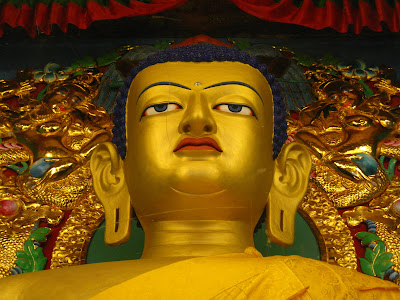
One thing about the Tibetan Buddhist cosmology that I am sure about is that it has way too many people with way too many forms for me to recognize, and I've been studying Buddhist art for 3 years now. There are a couple basics - Shakyamuni Buddha, Chenrizig, White Tara, Green Tara - that show up almost everywhere, but then they have a lot of forms and other gods have forms that look like them. When I guess, I'm usually wrong. The easiest ones to recognize as historical figures who have less forms and obvious distinctive features. Shakyamuni Buddha, as in the guy who lived 2500 years ago, is just a guy sitting on a throne and is usually the biggest in the room. Guru Rinpoche, (9th century) who founded Tibetan Buddhism, wears a lot of layers and a funny hat and carries a trident. In the non-human realm, Chenrizig has a crown, tends to hold a precious jewel, and usually has white skin. White Tara looks like Chenrizig but is making a different gesture. Green Tara looks like White Tara.

The historical Buddha is very intimidating. Also this statue was about 25 feet high.

I only know this is Heruka because the sign said so. I would have guessed Red Mahakalah and been wrong.

Guru Rinpoche, wearing cloaks, holding offering bowl and dorje, with a trident resting on his shoulder. He also has a moustache.

Manjurshi is always holding a sword but in human form, so I think this is him.The sword cuts away illusions.

A lot of people say that these idols are only supposed to serve as representations of the Buddha-mind and teaching tools, which for some people I guess they do, but that's also bullshit for the most part. No offense to Tibetan Buddhism at all - we should respect what they actually believe. It would be a bit like saying that Christians don't worship Jesus or pray to him, or think he existed, they just put up his image to remind them of how they should live their lives. Some Christians do this, but most don't. At every Tibetan shrine I've ever seen, there's been offerings at the feet of the statues of water in bowls, money, food, and flowers. People bow to the statues and pray in front of them. They leave offerings. They carry images of particular saints or gods around in amulets for protection. So accept this religion for what it is, a legitimate form of worship of a higher power (or powers) and don't impose your own viewpoint on it as I clearly just did.

The Dalai Lama's throne for teachings and pujas (offering services). Someone has left him a large Toblerone box. At least he has good taste in chocolate.

Monday, March 12, 2012

Yes, poverty exists


I assume not this room

My mom asked me to post about how "rural" the area I was living in is, which so far I've declined to do because I don't like talking about bathrooms or garbage. In comparison to true rural India, i.e. places people don't flock to year round to stare at the Dalai Lama's driveway (which he's never ON), this place is pretty damn cosmopolitan. And most people here have better living standards than slums in Mumbai or Delhi, because those are slums. But yeah, people are pretty poor here.

This is where I live

This area of Himachal Pradesh (the state Dharamsala is located in) is pretty posh. Most people have access to water that's usable for washing and only needs to be filtered or boiled before drinking, and if you drink a little of it (when you brush your teeth) you won't get super sick, so I don't know how "potable" that makes it. Buildings are made of cement, not brick or wood. There isn't any heat except via space heaters in the winter or A/C in the summer, but most people have access to some kind of electricity and running water. There are power outages but usually only a few times a week and not for very long, maybe an hour. The pollution, except for physical trash, is pretty low. Some people wear masks because it's dusty but I don't think it's that bad.

Maybe when I'm back in the States that paragraph will be a lot more depressing, but here I'm used to most things. The space heater thing, though, I really do not like. It doesn't really work anyway. Wearing your winter jacket around is OK, but the buildings are often the same temperature as the outside (or colder, because cement holds in cold during the day), unlike in America where you go from heated place to heated place. So at a cafe, they'll serve your meal really hot because they know it's going to cool off quickly and by the time you pay your tab, it's going to be ice cold. It's warming up a bit now that we're later into March, but this is a small window before June, when the monsoon comes and it doesn't stop raining until September.

The two main groups of residents in McLeod-Ganj, the specific area of Dharamsala where I live, are Tibetan refugees and Himachali Indians. It's hard to tell who's better off. The Tibetans have only refugee cards and limited access to the court system, can't own land, but live off money from abroad. The Indians are citizens who own land which they rent to the Tibetans, but they don't have huge benefits on their behalf at Radio City Music Hall. There's also a lot of transit workers, specifically Nepalese or people from the Punjab, the state next to Himachal, who have come because the tourism industry is good to people in comparison to working on a farm. Nepalese vendors try to pass their Nepalese art off as Tibetan and Punjabi Sikhs open restaurants with their specific style of food, which is good, but I'm still partial to Southern Indian food.


Then there are some people on the outskirts of McLeod-Ganj who are just rural poor. Sometimes they beg in town, but usually they work the land or take low-level construction jobs that are incredibly brutal and get mad when you take pictures of them. Construction is constant because of the tourism industry, to the point where it's actually starting to affect the structure of the mountain, and landslides are common in the rainy season.


There's also a ton of dogs here. Of cows I'd say there's a normal amount, but there's just a lot of dogs. People are too poor or uninterested in getting their pets neutered because it seems cruel to the animals, and so you wait 20 years and you have a lot of stray dogs and occasional rabies outbreaks. They are all pretty docile to humans, fighting only with each other and cows. BTW, the cows always win the fight.


I think everyone would agree that McLeod-Ganj has a major problem with trash. It's not for lack of trying to do otherwise. There are places to refill water bottles with filtered water. Soda in restaurants is served in bottles that are then sent back for refilling at the plant. Plastic bags are outlawed, so you either get your item at the door in a paper slip or a cloth bag. But the real problem is that it's a tiny city, and cities produce waste, and that waste has to go somewhere, but there's garbage trucks that I know of to carry the waste off. I've seen maybe one truck that looked like a garbage truck, and it was too large to go down most of the roads. People took away public trash bins but it had kind of a reverse effect, and now the roads and valleys are lined with chip bags and empty bottles. My building has four different bins for sorting trash (wet, wet paper, dry goods, recyclable) but I'll be damned if I know where it goes. There are recycling plants and bins, but the bins are far out of town on the road. I know people burn their trash, sometimes for heat and sometimes just to get rid of it, but usually only paper and in very small amounts, so you see burned paper on the side of the roads.


People have incense going all of the time, but it's mostly for religious reasons. There isn't a serious smell problem. I wouldn't say it smells great here - I would just say I haven't noticed any particularly bad smells except when a bunch of cows or donkeys are clustered together. And I live in New York, which is filled with bad smells. Mostly the streets smell of incense and cooking food, neither of which are bad except when highly concentrated.

There are a ton of signs posted everywhere about being responsible about the environment, but I seriously don't know a way that I can make less trash. Food comes in stuff. Napkins are used and it costs more to wash them and still uses energy. The only thing I've refused to do is give up toilet paper, because, you know.

The phones are pretty inconsistent. Landlines are particularly bad because people steal the lines in the ground to sell the copper. People also tend to buy the cheapest cell phones available and use them for six years, meaning by the end they hold no charge and don't work so well. There are outages in the the cell phone towers. People, when handing out their contact information, will give me three different numbers to try, knowing I may not get through at all.

All of that said, it's pretty livable here. I say that because I'm shelling out $200 a month for a really posh apartment that has a Western-style bathroom and a space heater. I'm sure some of you are thinking, "Damn, shell out another fifty and go to someplace better" but there aren't actually a lot of places that are going to be better, because some problems are city-wide. At a certain point you're just paying for atmosphere. Celebrities and dignitaries stay at Kashmir Cottage or Glenmoor, both of which are really nice and somewhat to American standards, but not cost-effective for a long stay, plus they're a taxi ride away from town, and you can get kicked out of your room if a member of the Spanish Parliament shows up. Richard Gere, I believe, lives at Kashmir and yeah, he is the real deal, spending a ton of the year here studying Buddhism and working hands-on in the community. I still don't think much of his movies, but give the guy some respect.

Anyway, feel free to panic about my health and safety in the comments section even though I feel fine, just maybe a little tired from the fact that every road is at like a 45 degree incline.

Saturday, March 10, 2012

Uprising Day

Yesterday was Uprising Day, a commemoration of the failed Tibetan Uprising of 1959 which ended with the Dalai Lama's flight into exile. In March 2008 in Tibet, it started as a peaceful protest and ended up with riots that left an unknown amount of people dead. There were also shootings in Tibet yesterday (as in, actually yesterday) when people gathered in the Aba Prefecture.

The march in Dharamsala was massive and woke me up, which was good because I wanted to see it. (No pictures because of Shabbos) The whole thing, led by monks and followed by lay people, took 15 minutes to pass my apartment complex. It started with people carrying makeshift stretchers with the Tibetan flag for the 25 people who've set themselves on fire (confirmed) in the past four months, and then the usual bits of people marching with flags, painted faces, and signs telling China to get out of Tibet. The women were mostly in traditional clothing and the men were mostly not. A few shaved their heads to write "Free Tibet" or "Save Tibet" on their skulls. There were people plastered with stickers of the 25 martyrs, or gruesome pictures of the deadly riots in January (yeah, that happened too) where policeman shot into crowds and beat people to death with clubs, which is obvious in the photographs (the Chinese government said they were acting in self-defense). The most consistent call was for the UN to help, and for China to get out of Tibet NOW, because there was an immediacy to it from the protestor's point-of-view.

It was all very depressing.

Not because of the pictures of people beaten to death or burning alive, because that's part of life. The whole spectacle of the day. I have to see this from an Israeli POV, because as a people, the Jews have a homeland, and we didn't get it by peaceful protest. Admittedly we had to give up part of our souls, and it began a prolonged struggle with our neighbors and created an impossible situation with the Palestinians which nobody fails to bring up when I mention this, but we have a country. We wandered for 2000 years, bought some guns, and now we have a country. Food for thought.

What the rally did:

(1) Strengthened the sense of community among Tibetan exiles around the world - Yes. This was the main purpose. There's a clear goal, a sense of purpose, a sense that the world hasn't forgotten about them and they haven't forgotten about themselves, and that they're getting something done, which is important to feel even if it's not true. They need to express themselves and they're in a country now where they have a certain right to do it, provided it's not near the border, or a Chinese embassy, or blocking too much traffic, or too visible to embarrass India. And they did it in Times Square, which got some attention from the AP.

(2) Showed solidarity with the six million Tibetans in Tibet - Yes and no. The Tibetans not in exile do follow events in India and other places, but are understandably more concerned with their own situation, and they have good reason to have little faith in the Tibetan gov't-in-exile, which has not been successful in doing anything for them. The Tibetans at home want the Dalai Lama to come back, and either don't know that he's stepped down as temporal ruler or don't care. (The Dalai Lama, BTW, was not at the rally, and has stepped down from politics in favor of an elected Prime Minister) Also, arrested Tibetans are almost always accused of being agents of foreign forces, particularly "the Dalai Lama's illegal government" so getting tortured for a government you didn't vote for, having nothing to do with, and isn't even run by the Dalai Lama anymore is no fun.

(3) Publicized the recent events in Tibet - Not really. The world has, at this point, decided how much it's going to care about Tibet, which is not a whole lot. There was a brief period of real concern in 2008, but China made it clear that (a) they would not listen to other people's opinions and would be highly offended by anyone expressing them, and (b) expressing such opinions will cause trade relations to be cancelled and financial losses incurred. When Hillary Clinton made her first visit to China as Secretary of State, she made a point in her speech of saying that "financial rights" were the most important issue, implying heavily that human rights were not, for which I was very disappointed in her as a person, as she had previously been a bit of crusader for women's reproductive rights in China. But there were practical reasons for doing it, like not letting the US economy take a blow so that some dissidents could be freed. You have to weigh your options, and the world has realized that our economies are two interconnected to upset one another.

(4) Given China any reason to consider giving Tibet any more freedom - No. The opposite, actually. China has a standard procedure of clamping down on any revolutionary actions within the country and a very xenophobic fear of outside influences seeking to undermine China's greatness (they are, for serious, still not over the Opium Wars of the 1840's). The very idea that there are outside forces seeking to disrupt the harmony that is the People's Republic of China is a great excuse to blame any internal dissent on outside forces and arrest homegrown Chinese protesters as spies for the West. Tibetans who are arrested are regularly tortured into giving up names of outside contacts they actually don't have, which prolongs the torture sessions because the prisoner is NOT a foreign agent, but that doesn't mesh with China's script about the Dalai Lama being behind every protest in Tibet, so the police just torture them more and give them a longer sentence for being uncooperative.

(5) Helping Tibet become independent - No. Even the Dalai Lama gave up on this in the 1980's, asking instead for the autonomy he was promised by Chairman Mao in the 1950's and is still included in the Chinese agreement with Tibet and the Chinese Constitution - the ability of Tibetan areas to control their own culture, religion, and language while China controls them financially, militarily, and otherwise. The fact that this initial promise didn't end up being true was WHY the Dalai Lama fled for his life to India and followed by 80,000 Tibetans, after ten years of trying to negotiate with the Chinese. China isn't about to give up a third of its landmass to anybody, much less some refugees wandering around some mountainous suburbs in India. It was about the equivalent of a Delaware Liberation Front marching for independence for Delaware on a football field in New Jersey while no one was around but the groundskeeper. Even the Indian cabbies didn't bother to stop running their cabs down the one-lane road for 20 minutes, cutting instead through the entire parade and forcing elderly marchers to the side of the cliff to wait for the cars to pass.

It's not all bad news. The Dalai Lama, often accused of inaction by condemning any effective methods of hassling the CCP (like, say, violence, or even boycotts), is clearly taking the long view. Tibet has withstood periods of cultural domination before. There was a three-hundred year period, from the reign of King Ling Darma in the 800's to the 1100's, when the Tibetan Empire collapsed and Buddhism was almost extinguished by the native Bon religion and local warlords. The Buddhism that emerged in Tibet - the religion the Dalai Lama, as a monk, is more concerned about than political borders - after that period was stronger and more diverse, leading to a golden age that produced some of Tibet's greatest thinkers. Politics are temporal and temporary. Human suffering is not ended by restoring creature comforts but by the realization of the truth - that desire causes suffering and a righteous life can lead to Enlightenment. He's looking to a future where all of humanity has achieved some level of enlightened consciousness and he believes that with everyone united by technology and trade and increasing education and understanding of each other, this is increasingly possible. If we know about each other we're more likely to care about each other, and if we care about each other, we'll stop working against each other. This is why he's very optimistic about China, because the PRC's artificially communist society only exists with misinformation and massive state controls, and those floodgates are going to open soon, maybe in his lifetime. Since he is concerned with every sentient being, even those in China, he can look to the future with a good deal more hope than the parade inspired.

But most people are not monks concerned with every sentient being. They are people concerned with their own suffering and the suffering of the people nearest to them, and the people in their lost homeland. I wouldn't be honest if I didn't end this post by saying that, in all honestly, those people would get closer to a free Tibet if next year they marched not to Lower Dharamsala but the Tibetan border - and they brought guns. Lots and lots of guns.

[Full disclosure: I'm not advocating an armed uprising, I'm just saying that it's a more likely route to a politically independent Tibet than any other I can see]

Thursday, March 8, 2012

Busy Day

Are people who are not my family reading? You're free to leave a comment. There's no sign-in required. I'm just curious.

2 interviews yesterday, at least one scheduled for tomorrow. That's coming along.

Shabbos Candlelighting March 9th: 6:09 PM IST

Today I got up at 6 to hear the Dalai Lama give his only public talk of March because you had to go through security and get a good seat. He spoke for three hours, presumably about Buddhism. If you bring a radio you can hear an English translation on 92.3 fm, and I learned the important lesson of never buying the cheapest possible radio in the shop the day before, because I didn't hear a damn thing until the very end, when I listened in on someone else's by sharing earbuds. He was discussing whether things existed or not (Buddhists agree with Plato, who argued things did not exist independently, and not Aristotle, who said the reverse, to oversimplify the issue), and then there was some Buddhist initiation where people were supposed to imagine tossing flowers at their Buddha family gods and then putting them on their heads or something like that. I'm not making this sound great in post but it was hardcore Tibetan Buddhism. Oh, and I got to say the prayer over seeing a gentile king again, for the third time in my life (all have been over him) so, yay.

Today was also the Hindu festival of Holi, where people spray each other with colored paint, because that's what you want all over your clothes. I actually know nothing else and had no time to learn because I was busy pretty much the whole day with Dalai Lama stuff or eating-after-long-speech stuff. Seriously, his speech went on and I was wondering when he was just going to have the Tibetan Exile President get up and read the weekly announcements and ask for shiva minyan volunteers.

Buddhists do not celebrate Holi to my knowledge, but all of the local Himchalis and a lot of the transit Nepalis are Hindu, so here are some pictures.


Monday, March 5, 2012

News from Tibet

I don't mind when it rains at night, because it's actually very beautiful to listen to. I do mind when it rains during the day, because my solar-powered shower doesn't work and it's hard to go anywhere.

Two people set themselves on fire over the weekend in Tibet - a mother of four and a student (most of them have been monks and nuns). This brings the total to around 25. There was an impromptu peace rally last night to pray for the martyrs and those suffering in Tibet. These are pretty common. Video below.


In between the march and the morning news, another person set themselves on fire, a male teenager named Jigme. What, you didn't hear about it? Well, we do a lot of business with China. When people ask me in America what's going on in Tibet, I just say, "Oh, it's so bad people are en setting themselves on fire. For serious. And then the police shoot them while they're on fire. And the people who sold them gasoline or lighters are charged with murder. So yeah, it's pretty bad."

Sunday, March 4, 2012

Long Weekend

I got my first interview on Friday. Short but emotional. I'll post more about it for Kickstarter later this week. In the meantime I'll just throw some pictures up.

A bunch of cows live near my apartment complex

Young monks buying fried momos for lunch

A monument to resistance fighters in Tibet. I believe this is new.

Monks at a prayer meeting that lasted all day, with breaks.

Monks

A young monk

Prayer in the Dalai Lama's main throne room of his temple

A Hindu boy dressed as Hanuman, the monkey god. Most of the local Himchalis are Hindu.

McLeod-Ganj is built into the hill next to the Dalai Lama's house, which is not visible here.

Donkeys are used to transport dirt as they dig into the mountains to build new hotels and shops

Monks in the Dalai Lama's temple complex